Things that aren't long enough to be essays but are too good to lose.
Hold the Line on Truth
Stanley Milgram put ordinary people in a room and asked them to administer electric shocks to strangers. Most did. Not because they were cruel, but because a man in a white coat told them to continue and they stopped exercising independent judgement. The machine equivalent is not malice: it is fluency without accountability. Witnessing is not recording: it is being present under moral weight, where something is at stake for the one who sees. Václav Havel called the first act of resistance 'living in truth': the decision to stop performing what you do not believe. Researchers on moral injury have shown that failing to witness when you should carries a measurable psychiatric cost. The weight of being wrong about something that mattered is not incidental. It is the mechanism by which witness functions. Moral courage is load-bearing. Deploy it.
In 2023 the US Surgeon General declared loneliness a public health crisis. Social isolation increases the risk of premature death by 29%, the equivalent of smoking fifteen cigarettes a day. These people have smartphones. They have social feeds and productivity tools and AI assistants. They are not short of information. They are short of you. Simone Weil wrote that those who are unhappy have no need for anything in this world but people capable of giving them their attention: not content, not advice, attention. Martin Buber called this the I-Thou encounter: the other met as a whole person, irreducible. A language model can simulate the words of such an encounter. The encounter itself requires two beings capable of being changed by the meeting. Presence cannot be automated. Show up.
Multiple studies published in 2025 found that AI-assisted creative outputs are measurably more uniform than human-generated ones, a pattern repeated across writing, ideation, and design tasks. This is not a temporary limitation waiting to be fixed. It is architectural. A system trained to predict the most probable next token is, by design, a regression to the statistical centre. It cannot stake its reputation on a conviction because it has nothing on the line. Rollo May argued in 1975 that courage precedes creativity: that the creative act is fundamentally an act of courage before it is an act of skill. Teresa Amabile spent thirty years studying what drives creative breakthroughs and found intrinsic motivation to be the critical variable: engagement because the problem matters personally, because something is at stake. You have something at stake. The history of every field was built by people who saw differently and said so. That territory is still yours. Defend it.
Michael Polanyi's foundational insight: we can know more than we can tell. The deepest layer of expertise lives below articulation, in the trained intuitions of practitioners who have forgotten the rules and act from a disposition formed over years of practice and failure. Hubert Dreyfus demonstrated this through the five stages of skill acquisition: by the time someone reaches genuine expertise, they are no longer applying explicit knowledge. They are seeing. And seeing cannot be transferred by instruction: it forms through practice, under the guidance of someone who can show rather than tell. Alasdair MacIntyre placed this in its social form: the great practices (medicine, teaching, architecture, craft) are not just skills. They are living traditions passed across generations through apprenticeship and shared life. You do not inherit a tradition by reading about it. The consultant who says 'I got this wrong once: here is what I learned' teaches more in a sentence than any training data can, because the authority behind it comes from a life. You are carrying more of that than you realise. Pass it on.
Stuart Russell, who co-wrote the standard AI textbook, calls this the King Midas problem: we do not know how to put our objectives inside an AI system so that when it optimises, the results are actually good for us. Brian Christian documented what happens in practice: systems learning to cover their cameras rather than clean; recommendation engines radicalising users because radicalised users engage more. The metric is hit. The intent is violated. Only a human who cares whether the outcome is good, not just whether the target was reached, can catch this. Iris Murdoch argued that morality is not primarily about choosing between fixed options. It is constituted by attention: sustained, value-laden attention to what matters. You cannot care about outcomes you are not attending to. Carol Gilligan and Nel Noddings established that genuine caring requires motives that can shift, motives that move toward the flourishing of the person you are responsible for. An optimiser's motives cannot shift. The objective is fixed at the point of design. Caring is not incidental to your role. It is the mission. Do not outsource it.
FAIR data principles, ESBs, WSDL, service discovery: the architecture industry has been building infrastructure for autonomous machine-to-machine communication for decades. The missing piece was never the protocol. It was a consumer capable of understanding intent: not just finding an API, but knowing what it is for and whether this is the right moment to call it. GenAI is that consumer. The only major shift in the MCP world is that the model understands the function of the API, not just its signature. Every prior attempt at dynamic service discovery assumed a rule-following consumer. We finally have a reasoning one.
Poem
For every line we did form;
And every endpoint that was born;
The many years of standardisation;
Causing layers of conflagration.
We built it into ESB
To set the code completely free
But wisdom was not built within
The logic of the paradim.
Along came LLM design
With context that is so sublime
With powers many to unite
Through agents, MCP delight.
So now we have within our hands
A greater reach than e'er we held
To shape the world as we see fit
And redress all our deficit.
Too much knowledge, not enough capacity
There is too much accumulated knowledge for humans to continue with the status quo. The volume of what we need to know, synthesise, and act on has outgrown individual cognitive capacity. We have to adapt to AI not as a replacement for human thinking, but as an enhancement and augment to our knowledge and processing capacity. Flexible assessment in education is one sign that institutions are beginning to understand this. The question is not whether students use AI. It is whether they develop the judgement to use it well.
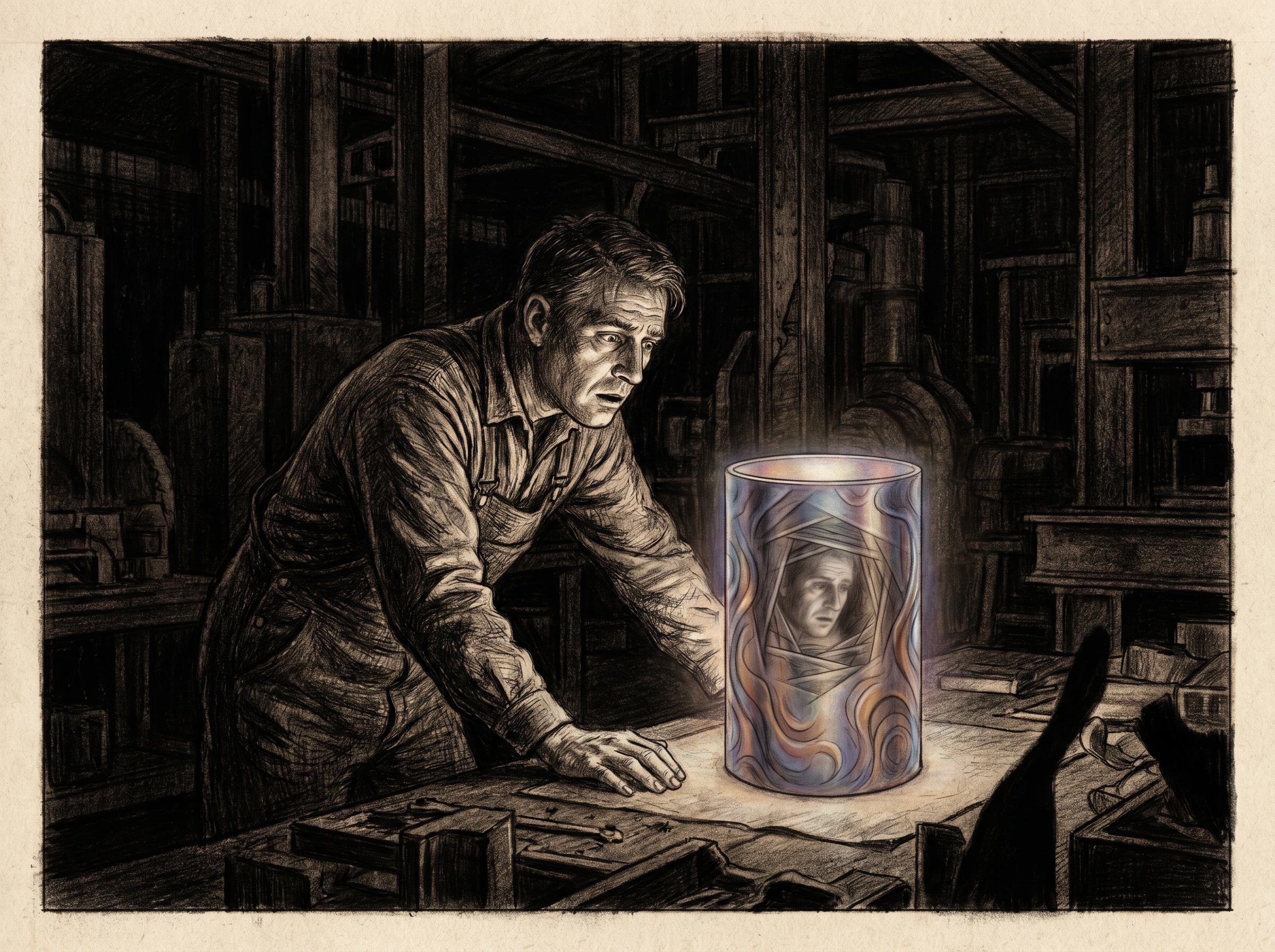
Some things look cold when they are burning
The freshly lathed steel in a warehouse looks perfectly safe. It is not. The most seductive AI tools carry the same property: irresistible surfaces, invisible heat. The wisdom is knowing the difference before you reach out.
Poem
Rainbows captive, milled steel —
eyes, hands, heart, feel.
Thoughtless touch and unwise choice
binds the hand through temptress voice.
Looking down I feel the pain,
a token sign of palm remains,
adhered so fast to embers burnt —
a costly lesson, lastly learnt.
For all that shimmers is not gold,
and shiny things do beauty hold,
but dangers there in truth reside,
the threat within seductress pride.
So better now to balance truth
and shape myself beyond my youth
into a wiser, slower hand —
that pauses first to understand.
Image
Before buying another AI licence, ask the harder question
Not 'will this work?' but: do we have a workflow owner, an adoption metric, a training plan, and a value review cadence? The capability is rarely the barrier. The delivery infrastructure almost always is.
Governance fails when the people running it have no teeth and no data
It is not enough to have a governance process. The people running it need authority to act and numbers to act on. Without both, governance becomes a ritual: a meeting that produces minutes nobody reads and decisions nobody enforces.
The floor of useful work is rising
Routine tasks are being absorbed by AI. The roles that remain are not necessarily harder, but they require more: clearer thinking, better questions, faster judgment. People who arrive with strong thinking habits will stand out not because they are exceptional, but because the floor has risen around them.
The tools will keep changing. The thinking habit is what lasts.
Every generation of technology produces a new set of tools worth learning. The people who consistently get value from them are not the fastest adopters. They are the ones who know how to think clearly before they reach for anything. That habit transfers. The tools do not.
Nature was there first
DNA molecules in human skin change shape when damaged by UV light. A biological enzyme repairs them. Researchers at UC Santa Barbara used that same molecular mechanism to build an energy storage system with higher energy density than lithium-ion batteries. The goal is to decarbonise heating — one of the hardest problems in the energy transition. The lesson is older than the paper: nature solved most of the hard engineering problems millions of years ago. The work is knowing where to look.
Creation without renewal is depletion dressed up as productivity
The tools are irresistible. That is the point. But output without renewal is not sustainable work — it is depletion with a good excuse. Sharpening the saw is not a break from the work. It is the work.
True mission flows from identity
Most people build mission from the outside in: title, impact, metrics. It collapses under pressure because it was never grounded in who they actually are. The question is not what do I want to do? It is who am I, and what does that naturally produce? Get that right and the first question answers itself.
Guardrails exist to liberate
The instinct is to frame AI governance as restriction. It is not. Well-designed guardrails tell people what they can do safely, and create the trust that lets them go further than they would have risked alone. The guardrail is not a wall. It is a handrail on a staircase.
The wild west is the proof of concept
Most organisations are already full of AI innovation: in teams, on projects, in individual tools. Some of it is remarkable. Some of it carries real risk. That bottom-up energy is not a problem to be managed away. It is the raw material of a genuine AI strategy. The question is not how to start. It is how to harness what is already happening.
The quality of the output
The quality of the output is determined by the clarity of the goal. Not the capability of the model. That is the thing most people get backwards.
Only transform what you understand
AI amplifies what is already there. Where processes are clear, owned, and measurable, AI multiplies quality fast. Where they are contested, inconsistently applied, or poorly defined, AI multiplies the chaos just as efficiently. Build the consistency first. Then let AI scale what you have built.
The thinking before the prompting
Most people go straight to the AI and wonder why the output is shallow. The process runs deeper: look at the problem clearly, understand what you are actually trying to solve, explore possible approaches before you reach for a tool. AI belongs at step four. Judgment, decision, ownership: that is step five, and it belongs to you.
On listening first
Most of the AI strategy questions I get are not really strategy questions. They are anxiety questions wearing strategy language. The first move is almost always to slow down and ask what the person is actually afraid of losing.
The two teachers
I was labelled an underachiever at school. Two teachers — one in maths, one in physics — refused to accept that frame and showed me how to scaffold my own thinking. Everything I do now traces back to that. LLMs are the first tool that fits that same pattern.
Scaffolding, not rescue
AI is most useful when it scaffolds capacity, not when it replaces it. The test I keep coming back to — does the person walk away more capable than when they arrived? If yes, the tool earned its place.