Action
The real fight is adoption
Data technology keeps getting blamed for everyone else's bad habits. The question isn't whether the tech is good. It's whether we're ready to adopt it properly.
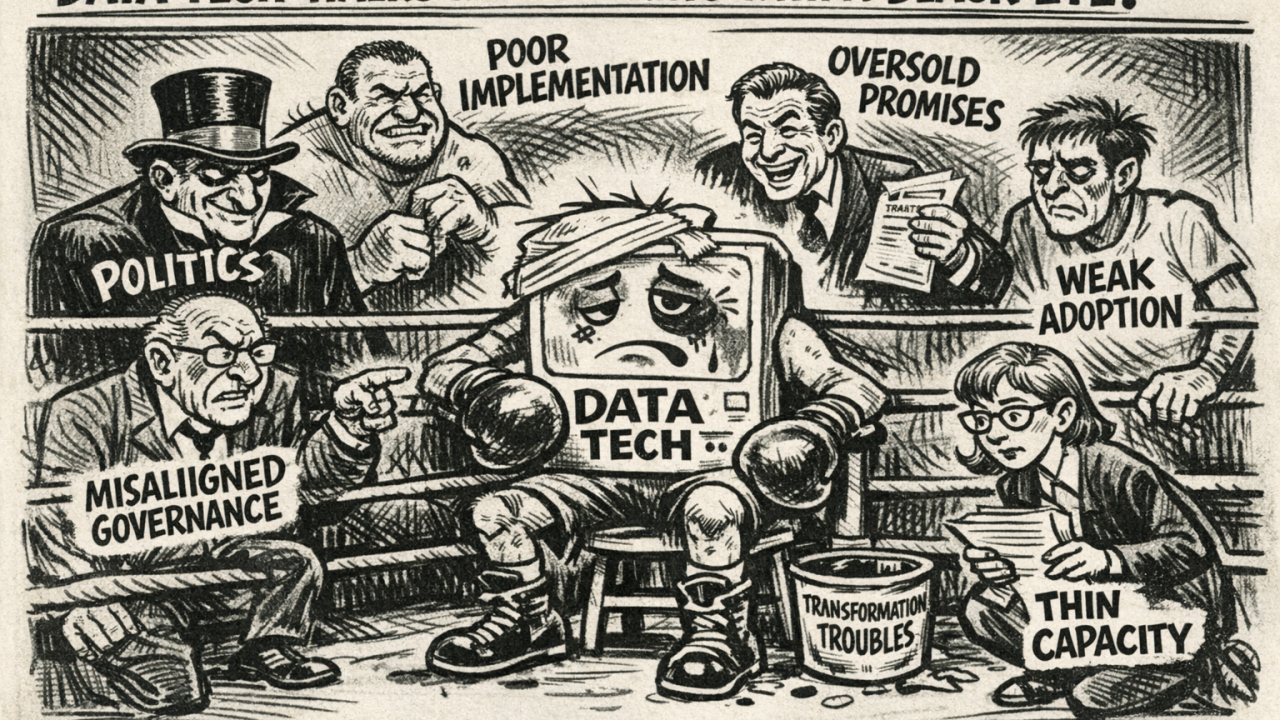
Data technology walks into the ring with a black eye.
Not because it cannot fight. Not because it is not world-class. But because it keeps getting blamed for everyone else's bad habits.
We tend to vilify platforms when the real harm usually comes from outside the codebase: public narrative, poor implementation, oversold promises, weak adoption, misaligned governance, thin organisational capability, and transformation programmes that treat change like a footnote. Add poor communication — and technology becomes the easiest opponent in the arena.
Don't blame the tool. Blame the tale.
You can see this dynamic playing out with the data platform adopted by the NHS. It attracts plenty of challenge, much of it rooted in how it was positioned and introduced, rather than what the platform is actually capable of. My opinion: Foundry is a capable product with the potential to move organisations from dashboards to decisions, and from decisions to delivery.
Maybe I'm biased because I still remember when there were only one or two books that held limited knowledge to resolve issues — how our knowledge has grown! I've lived the whole arc: assembler, procedural C, Informix 4GL, SQL, into C++/C#, event-driven models, and now modern data platforms, methods, and low-code/no-code ecosystems. So when you see a platform that can genuinely integrate across no-code, low-code, Python, SQL, and AI — with end-to-end traceability and lineage — you cannot help but appreciate how far we've come.
The question is not only "Is the tech good?" It is: are we ready to adopt it properly?
Because the technologist of the future is not just a builder of systems. We are curators of capability — in technology and in people. Our job is to make value real:
- Align governance to outcomes
- Build adoption like a product
- Strengthen organisational capability and capacity
- Obsess over business benefits more than the narrative around the tool
So before we throw the next platform back into the ring as a punching bag — maybe we should ask whether the real opponent is our delivery model.