Reflect
Out of the strong
On the full cost of AI, the fragility of what we build, and why that might be exactly the point.
My dad was an engineer and I have always been fascinated by machines. There is a machine that I think is incredible.
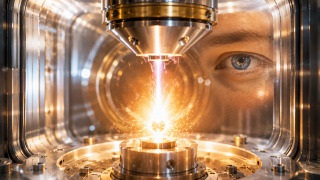
It is built by a Dutch company called ASML. It takes over a year to assemble. It draws on more than 800 suppliers. The latest generation is still produced in small numbers, with annual shipments measured in single digits and long-term ambitions far beyond that. It fires a laser at a tin bead, generating plasma hotter than the surface of the sun. That plasma emits extreme ultraviolet light. That light is then used to etch features onto silicon chips at a scale so small the word "tiny" doesn't come close.
This machine is one of the reasons your AI assistant exists. Most people asking it to write their emails have never thought about that once.
I find this extraordinary. Not just the engineering, though the engineering is extraordinary. I find it extraordinary that we built something this complex, this fragile, this dependent on a global web of precision suppliers, and we treat what it produces as if it were water from a tap.
The weight we don't count
When we talk about AI, we tend to talk about capability. What can it do? How fast? How accurate? How much does the subscription cost?
We rarely ask the other question: what does this actually cost the world?
AI creates real value, for individuals, for organisations, and through the way humans and machines can genuinely work together. But all of it has a cost we tend not to put on the invoice.
The power consumed by the processors running the workload. The heat generated and vented. The hardware built at extraordinary cost and replaced on cycles driven more by commercial incentive than environmental logic. The data centre humming somewhere, cooled at scale. The security infrastructure layered around it. The supply chains, the shipping, the rare earth minerals, the labour.
And we have yet to see the true bill. The companies building these models are investing at a scale that has no precedent in private enterprise. The returns, if they come, will be transformative. But the full invoice, when it finally arrives, will be larger than the current conversation suggests.
None of this appears in the prompt response time. But it is all there. Some of it is being addressed: renewable-powered data centres, efficiency gains from each model generation. None of it has disappeared.
The argument is not to stop building. It is to stop pretending the building is weightless.
The real danger is not that AI costs too much. It is that abstraction makes the cost feel unreal.
But the cost the invoice misses most completely is not energy or hardware. It is the cost of looking honestly at what the machine reflects back.
The mirror
Here is the thing that has been sitting in my brain, refusing to leave.
AI is not malicious. It is not intentionally strategic or conscious. But the shift in AI capability has heightened our system vulnerabilities in ways we did not fully anticipate. Not because AI attacks us, but because our systems, built by humans, carry human flaws at a scale we can no longer ignore.
The code we have built is like us: vulnerable. The hardware we have built is like us: vulnerable. The models we have trained are like us: vulnerable to abuse, to misapplication, to the gaps and biases we embedded without meaning to.
We made these systems in our image, and they carry our flaws with the same fidelity they carry our capabilities.
Those who probe for vulnerabilities in systems recognise this. Those who seek to exploit gaps for nefarious purposes recognise this. Psychologists recognise this. The question is whether we are willing to.
AI has not so much become a threat as it has become a magnifier. It was always a mirror. The mirror just got bigger. What it shows has not changed.
We are imperfect and glorious, usually at the same time.
Out of the eater
A colleague once told me about Kali, the Hindu goddess who embodies time, change, destruction, and in some traditions liberation through it. She is not the enemy of creation. She is part of it. The destruction makes space. The chaos precedes the order. My colleague believed, and I have come to understand, that you cannot separate the two.
There is a riddle in the book of Judges. Samson, having killed a lion, returns to find a swarm of bees has made honey in the carcass. He poses the riddle to his adversaries:
Out of the eater, something to eat; out of the strong, something sweet.
Something alive and nourishing, born from something violent and dead. Not in spite of the mess, but through it.
We have always built on fragile foundations. The entire history of human technology is a story of dependency chains with holes in them, of assumptions that turned out to be wrong, of systems that failed in ways their designers never imagined.
And then, somehow, of people who found a way through and built something better.
AI is not different from this. It is the latest chapter of it. The foundations have holes. The mirror is uncomfortable. The costs are real and under-counted. All of that is true.
And from the carcass, there is honey.
Eyes open
We are at a juncture. Not a unique one in the history of human innovation, but a significant one. The scale and pace of what is changing means the choices we make in the next few years will shape things for a long time.
We can go in blind. Follow the hype. Deploy without thinking. Ignore the costs. Mistake capability for wisdom. That path is well-lit and well-populated.
Or we can open our eyes.
Ask the harder questions. Be honest about what we are spending and what we are building. Choose where to apply this technology because it genuinely serves human flourishing, not because it is available and fashionable.
Carpe diem. Seize the day.
Or, as my brother prefers: carpe dentum. Seize the teeth.
Maybe that is closer to it. The teeth are real. The risk is real. Seizing the day means seizing all of it: the extraordinary capability and the uncomfortable mirror, the honey and the carcass, the plasma hotter than the sun and the question of what we are heating the planet to produce.
I am an observer by nature. I watch ecosystems form and fracture and reform. I see the fragility and the resilience in the same moment.
What I keep coming back to is this: we survive not because we are perfect, but because we are persistent. Not because we build on solid foundations, but because we learn, eventually, to reinforce the ones we have.
The question is not whether AI will expose our imperfections. It already has.
The question is what kind of honey we are prepared to make from the carcass.