Action
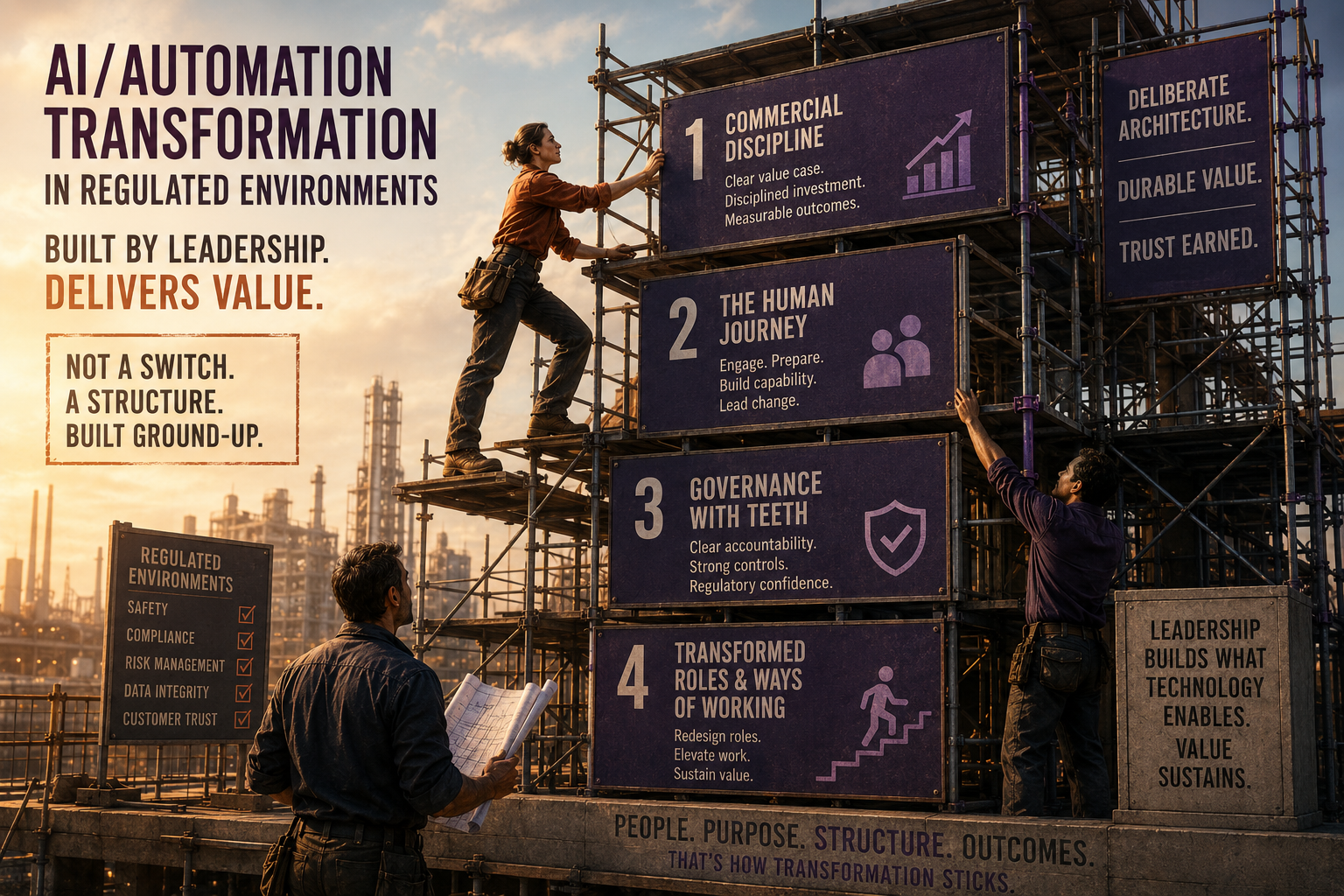
Four Things Leaders Must Get Right on Automation and AI
The automation opportunity is not just a growth play. For many organisations it is increasingly a capacity question. What separates transformation that lasts from programmes that fail to return benefits.
I have led and advised on Automation and AI programmes in regulated environments. Some genuinely transformed. Others failed to return benefits. The difference was rarely the technology.
McKinsey just put a number on the opportunity: $1.9 trillion of economic value across Europe by 2030, with 58% of work technically automatable. Those numbers are real. Europe also faces compounding workforce pressures: shrinking and aging populations, persistent labour shortages, slower productivity growth than peers. The automation opportunity is not just a growth play. For many organisations it is increasingly a capacity question.
The organisations that capture it will have got four things right.
Count the commercial cost. Not a pilot. Not a proof of concept for the sake of it. A proper benefits case: ROI, realisation timeline, accountable ownership. I have seen substantial Automation and AI programmes run for eighteen months with no one accountable for the benefits case. It happens more than people admit.
Invest in the human journey. Workflow redesign isn't a technical project. It is an organisational change project. The difference with AI is that the change happens to the cognitive content of the role, not just the process around it. The people in those workflows need time, support and genuine leadership to mature into new ways of working. Skip that and you get resistance, workarounds and eventual abandonment.
Build governance that governs. The question isn't only "does this work?" It is: are we still aligned to the vision we set out? Are we delivering to the levels we expected? Can we measure it? Governance fails when the people running it have no teeth and no data. The mechanism only works when it has both.
Redefine the transformation roles. One of the best examples I have seen was in a hospital trust where Business Analysts and Change Managers were brought together and reframed as Transformation Leads. Not a rebrand: a genuine repositioning of two complementary disciplines. It only works when the analytical and relational capabilities are genuinely integrated, not just co-located. When it does, the result is adoption that lasts.
McKinsey's own data (Exhibit 11, Agents Robots and Us: How AI Reshapes Work and Skills in Europe, 2025) shows business analysis rising faster in AI-era job postings than almost any technical AI skill. Because transformation needs people who understand both the system and the person in it.
The question for leaders isn't whether Automation and AI will reshape your organisation. They will. The question is how intentionally you lead that reshaping.
Which of these four is hardest in your organisation right now?
McKinsey MGI: Agents, Robots and Us — How AI Reshapes Work and Skills in Europe